
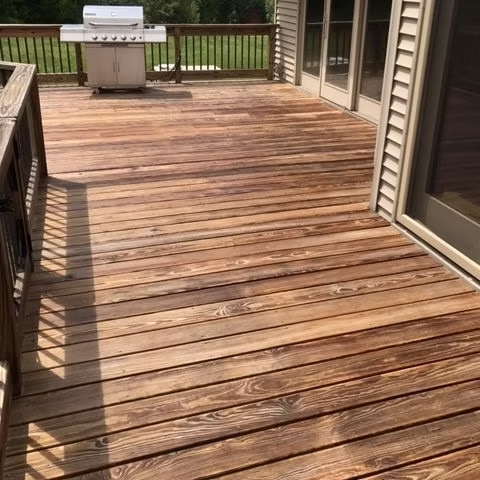
Choosing a stain is one of the biggest decisions in any deck project, and the most common question we hear is semi-transparent vs. solid deck stain. Both protect wood, but they look and wear very differently, especially on a sunny lakeshore deck.
How Deck Stains Differ
Deck stains range from nearly clear to fully opaque. The more pigment a stain has, the more it hides the wood grain and the more UV protection it offers. But more pigment also means the stain behaves more like paint.
- Transparent / toner: shows almost all of the grain, least UV protection, needs the most frequent recoats
- Semi-transparent: adds color while letting the grain show through, good UV protection, soaks into the wood
- Semi-solid: mostly hides the grain with a hint of texture
- Solid: hides the grain completely, like paint, and forms a film on the surface
Semi-Transparent Stain
Semi-transparent stain penetrates the wood instead of forming a thick film on top. That means it wears away gradually rather than peeling. When it is time to refresh, the deck usually needs a cleaning and a new coat, not a full strip. Most homeowners love how it shows off the natural beauty of cedar and pine.
- Pros: natural look, does not peel, easy to maintain
- Cons: needs recoating every two to three years, does not hide stains or mismatched boards
Solid Stain
Solid stain gives a uniform color and hides older, weathered or patched boards. It also blocks the most UV. The trade-off is that solid stain forms a film, and on horizontal deck boards that film is prone to peeling once water gets underneath. When it fails, it often has to be stripped before restaining.
- Pros: uniform color, hides imperfections, strong UV protection
- Cons: can peel on walking surfaces, harder to refresh
Which Is Better on a Lakeshore Deck?
For most deck floors along Lake Michigan, we recommend a quality semi-transparent stain. It handles moisture better, wears more evenly and is far easier to maintain. Solid stain can work well on railings, skirting and vertical surfaces, or on older decks where hiding the wood is the goal. Dense hardwoods like ipe need a different product entirely; see our guide to restoring Brazilian hardwood decks.
Prep Matters More Than the Product
No stain lasts if it goes on over dirt, mildew, old peeling finish or damp wood. Proper cleaning, brightening, drying and sanding are what make any stain perform. Learn more in our step-by-step guide to deck sanding and staining.
Need help getting your deck ready? The Lake Deck restores decks all along the Lake Michigan shoreline, from New Buffalo to Holland. Call or text 269-292-2612 or contact us for a free estimate.